
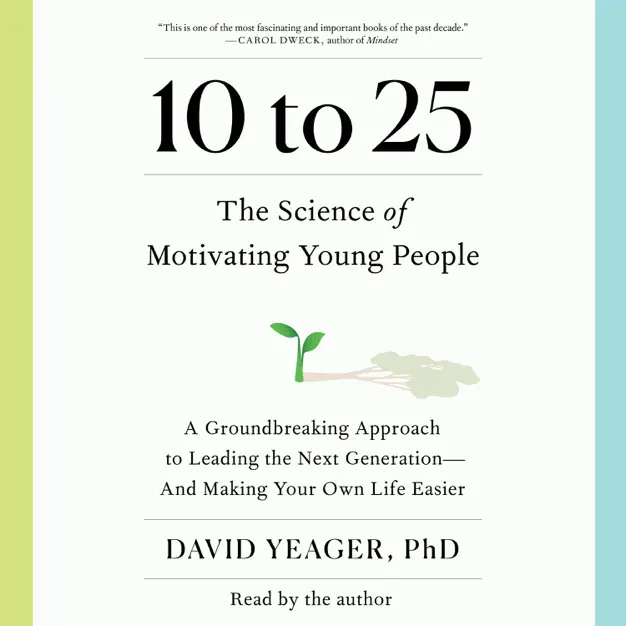
Book Review: 10 to 25: The Science of Motivating Young People
By: Sophie Martin
I loved this book! I have been working in the field of education for more than ten years, and one thing has always perplexed me: no matter how much effort went into the work (the vaping interventions, the consent workshops, the “don’t share intimate pictures online” talks, etc.), I could never be certain any of it was actually landing. I had models, frameworks, and the right structures. What I didn’t have was an answer to the question that followed me out of every room: “How do I actually get through to them?”
Reading David Yeager’s 10 to 25: The Science of Motivating Young People, I realized why. I had been thinking about teenagers all wrong, and my students deserved the version of me that had read this book.
Honestly, this should be mandatory reading for anyone who works with young people.
In 10 to 25, Yeager gets to the science early, describing the neurobiological-incompetence model: the assumption that teenage behavior is simply the product of an unfinished brain, that young people struggle to control their impulses or make sound decisions because the relevant parts of the brain (what scientists call executive functions) haven’t fully developed yet. It sounds very scientific, but what is striking about the way Yeager unpacks this concept is how practical and down-to-earth it is: he is not writing for academics, he is writing for the people in the room. And what he shows is that we have dramatically overstated it. The most powerful driver of young people’s behavior isn’t their developmental stage; it’s whether the adults around them treat them as already capable of good judgment.
Our greatest living philosopher, one Taylor Swift, puts it plainly: “When you are young, they assume you know nothing.” And teenagers know it. So, they apply the same model right back at us: we, the oldies, misunderstand their music, their humor, their language, their whole way of moving through the world. But the dismissiveness runs in both directions.
What Yeager argues, carefully and convincingly, is that someone has to go first. If you are the adult in the room, that someone is you.
If you work with young people aged 10 to 25, you need to read this book (I can’t stress this enough). It is full of practical, grounded strategies for doing the hardest thing in that work: convincing a young person that you actually have their interests at heart. That is not a soft skill. It is a craft, and Yeager treats it as one. The stories he includes are told with real compassion, and they make clear that the adults who get this right are not doing something magical; they are doing something learnable.
If you also feel like nothing is getting through, read this book: not because it will reassure you, but because it will redirect you firmly but compassionately.
Reading this book helped me notice the moments when my own thinking slides into a quiet “those youths” energy: impatient, slightly superior, already checked out. Yeager’s great gift is making you recognize that that is not a teenager’s problem, but our problem. And that is one issue we are actually equipped to solve.
Share This Story, Choose Your Platform!
About the Author: eedev









Leave A Comment